Peer Review Process
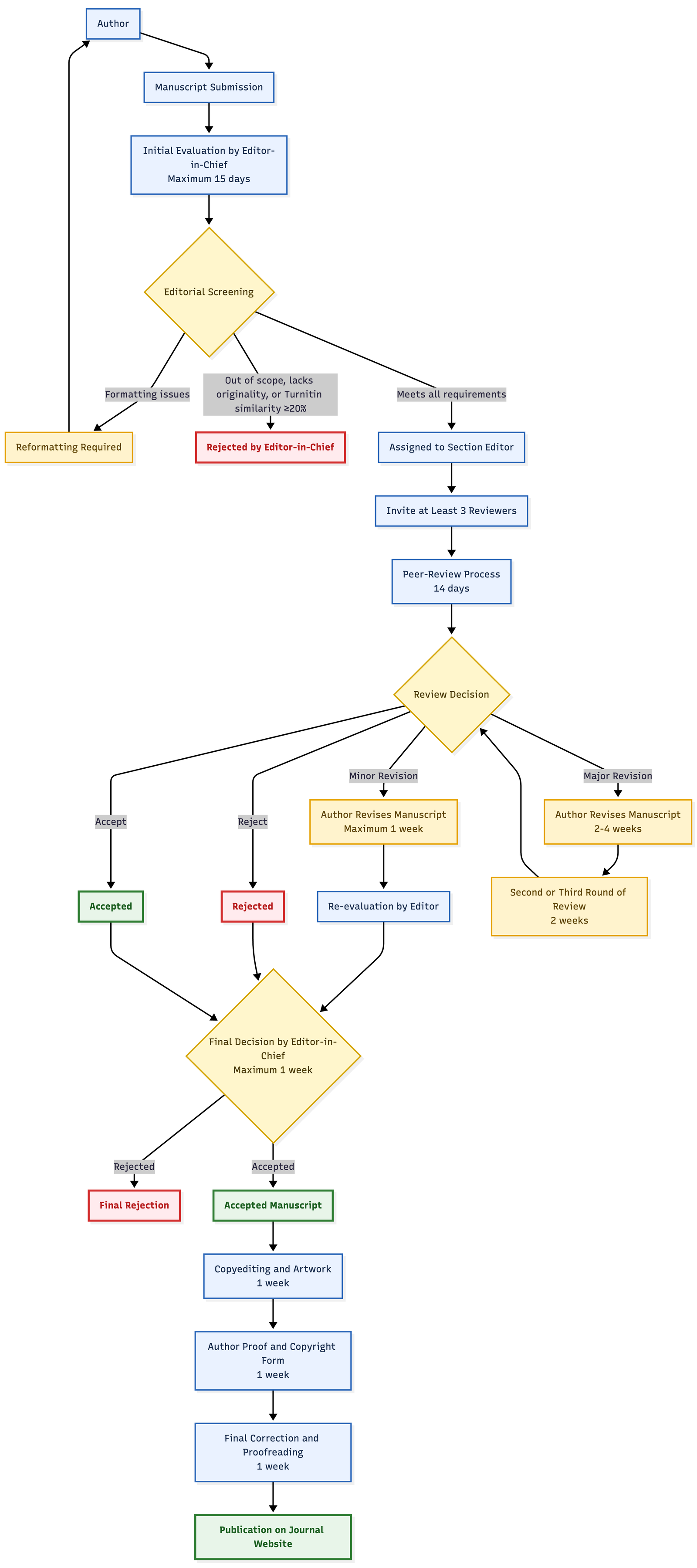
Every submitted manuscript undergoes editorial evaluation and peer review to ensure its relevance to the journal’s scope, originality, scientific quality, and compliance with the journal’s author guidelines. The journal applies a double-blind peer-review system, in which the identities of both authors and reviewers remain confidential throughout the review process.
1. Manuscript Submission
Authors must submit their manuscripts through the Open Journal Systems (OJS) platform. Each manuscript must comply with the journal’s template, formatting requirements, and author guidelines.
2. Initial Evaluation by the Editor-in-Chief
The Editor-in-Chief conducts an initial evaluation within a maximum of 15 days after the manuscript is received. This evaluation covers:
-
Relevance to the journal’s focus and scope;
-
Completeness and compliance with formatting requirements;
-
Originality and scientific contribution;
-
Compliance with publication ethics; and
-
Similarity screening using Turnitin.
A manuscript with a Turnitin similarity score of 20% or higher will not proceed to the peer-review stage and may be rejected by the Editor-in-Chief.
If the manuscript is relevant to the journal’s scope but does not comply with the required format, it will be returned to the author for reformatting and resubmission.
3. Assignment to a Section Editor
A manuscript that passes the initial evaluation will be assigned to a Section Editor. The Section Editor is responsible for managing the peer-review process and inviting at least three reviewers whose expertise is relevant to the manuscript’s subject.
Reviewers must be independent and must not have any conflicts of interest with the authors, the authors’ institutions, or the research being evaluated.
4. Peer-Review Process
Reviewers are given a maximum of 14 days to evaluate the manuscript. The assessment covers:
-
Novelty and originality of the research;
-
Clarity of the research problem and objectives;
-
Appropriateness of the research methodology;
-
Quality of the analysis and discussion;
-
Consistency of the conclusions with the research findings;
-
Relevance and currency of the references;
-
Clarity and quality of the manuscript presentation; and
-
Contribution of the research to the relevant field of study.
Based on their evaluations, reviewers may provide one of the following recommendations:
-
Accept;
-
Minor revision;
-
Major revision; or
-
Reject.
5. Minor Revision
Authors whose manuscripts receive a minor-revision decision must submit the revised manuscript within a maximum of one week.
The revised manuscript must be accompanied by a response-to-reviewers document explaining how each comment has been addressed. The editor will re-evaluate the revised manuscript before proceeding to the final decision.
6. Major Revision
Authors whose manuscripts receive a major-revision decision must submit the revised manuscript within two to four weeks.
A manuscript requiring major revision may be returned to the reviewers for a second or third round of review. Each additional review round is expected to be completed within a maximum of two weeks.
Authors must respond systematically to all reviewer comments. If a recommendation cannot be implemented, the author must provide a clear and academically justified explanation.
7. Final Decision
The Editor-in-Chief makes the final decision based on the reviewers’ reports, the author’s revisions, and the Section Editor’s recommendation. The final decision will be issued within a maximum of one week after the evaluation process has been completed.
The final decision may be:
-
Accepted for publication; or
-
Rejected.
The decision of the Editor-in-Chief is final. A manuscript that has been accepted must still complete the editing and production stages before publication.
8. Editing and Production
An accepted manuscript will proceed through the following stages:
-
Copyediting and layout preparation by the journal’s editorial team within a maximum of one week;
-
Author proofreading and submission of the copyright form within a maximum of one week;
-
Final corrections and proofreading within a maximum of one week; and
-
Publication on the journal’s website.
Authors must carefully review the proof. At this stage, changes are limited to typographical errors, layout issues, and other minor corrections. Substantial changes to the manuscript’s content are not permitted.
9. Ethics and Confidentiality
Editors and reviewers must maintain the confidentiality of submitted manuscripts. They may not use any information, data, arguments, or findings contained in a manuscript for personal purposes.
If a violation of publication ethics is identified—including plagiarism, data fabrication, duplicate publication, citation manipulation, or an undisclosed conflict of interest—the journal reserves the right to terminate the review process or reject the manuscript at any stage.